
January 2026- Salt and Stone Knits
January’s Beanie Brigade is here, and we’re starting the year with a Merino Worsted, spun from 100% Superwash Merino Wool (Full Skein: 218 yds / 100g, Half Skein: 109yds per 50g). This yarn is smooth, sturdy, and deeply comforting, exactly what you want on your needles when winter is still in full swing. It offers beautiful stitch definition while staying soft and wearable.
This month’s colorway set we named 'Embark', setting the tone for a fresh start in 2026. Grounded and warm it feels right at home in midwinter and pairs effortlessly with the Velsen Hat by Salt & Stone Knits. This hat is a thoughtful, well-balanced pattern that lets both the yarn and color shine. The structure of the Velsen Hat works beautifully with Merino Worsted, resulting in a hat that’s classic, practical, and satisfying to knit.
We’re excited to share a conversation with Salt & Stone Knits about the inspiration behind the Velsen Hat and their design process.

January Designer: Mieka of Salt and Stone Knits

Q: Can you please take a moment to introduce yourself?
A: Hello! I’m Mieka and I’m a knitwear teacher and designer originally from the New York City area but for the last 9 years, I’ve been lucky to call Amsterdam, the Netherlands “home” too. I enjoy taking knitting techniques like intarsia, steeking, tuck stitches, etc. and breaking them down from different angles to help all kinds of learners understand the topic and wield them in their next project or design.
When I’m not knitting or teaching, I’m painting, drawing, shooting archery, traveling, thrifting, cycling, weaving or playing with my adorable cat, Juniper! I am a huge gadget nerd (both high and low tech), will remember the discount I get on items I bought a decade ago, can get super excited about backpacks and am extremely proud of myself when I can creatively McGuiver everyday objects into solving silly problems in my life.
Q: The Velsen Hat is the featured Beanie Brigade project for January 2026! With its long folded brim and playful three-color mosaic body and crown, it’s such a fun design. What sparked the idea for this hat?
A: I encountered the stitch when I was developing a slip stitches class. The textured, layered look of this asymmetric mosaic pattern felt perfect for a hat. Intriguing from afar so that you want to flip it to the WS to see how it’s made and even more mesmerizing when you realize how simple and easy it is to create! I always prefer the silhouette of a fitted beanie but it can be elongated for a slouchier look too if you prefer.
The clean bend of the double brim and the satisfying squish of the ribbing was a must. I’m someone who’s always late and on the run so being able to throw this hat on as I’m jumping on my bike without worrying if the brim was folded correctly is very important! I enjoy envisioning the scenes in which my designs become part of everyday life and use that to shape the design choices I make.
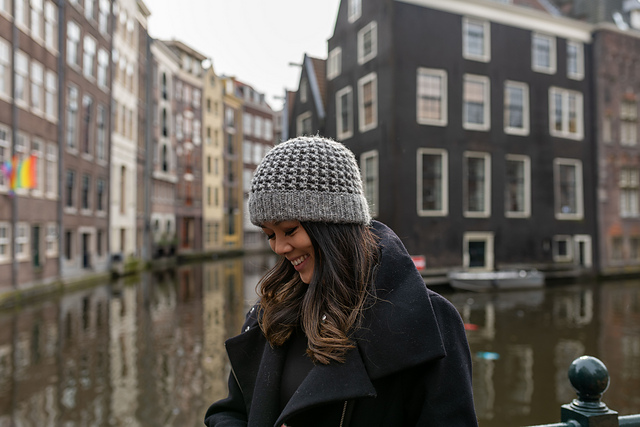
Q: On Ravelry, you’ve mentioned that your work as a knitting teacher often shapes your pattern designs, especially when techniques you’re teaching find their way into future projects. What are some of your favorite techniques to teach (and why)?
A: Across all techniques I teach, my favorite thing to do is to distill a technique down to all its functions. Not just what that technique is known for, but other less obvious by prothat can be wielded.
For example - thrumming, adding unspun fiber into your knitting, is best known for its soft insulating layer and warmth. But another hidden function of thrumming is that it has the ability to add a freeform textured pop of color somewhere! You can add a single thrum just just for its color and texture while many other color techniques such as stranded knitting and intarsia have limitations that don’t easily allow for that.
Looking at my classes this way brings the full potential of the technique into view and opens it up to being used in more creative ways the next time the knitter is going to modify a pattern or create a design. I often don’t have my own examples of all the functions so I love spotlighting incredible designers who have pushed these techniques in different directions and show off their brilliance as inspiration to my students.

Q: What has been one of your proudest moments as a knitting teacher?
A: If students feel comfortable learning out loud, that is when I am most proud. Taking on something new as an adult can feel intimidating, especially in front of other people. I work to create a space where my students feel comfortable making mistakes, asking questions or sharing when it all clicked for them. And with each remark, I can feel others start to feel more comfortable as they’re learning a new skill and seeing knitting in a different way.
I design the class for different learning types but each time, I learn something new from my students too. I listen and take notes on how my students experienced it and what questions they had. They help me shape, sharpen and improve each class so that the next time I teach it, more people feel seen, heard and comfortable. I’m proud to provide a space for them to learn and proud to learn from them as well.
Q: This year, you’ve been sharing more of your oil pastel drawings on social media. Have any of your illustrations inspired your fiber projects, or have your fiber arts ever influenced your drawings?
A: I’m currently playing around with an idea for my first small collection of art. This is very scary to me but also very exciting! The theme would be my favorite breeds of sheep.
The fire of trying my hand at a new craft has been pulling me towards all different mediums. So instead of fighting that, I’m embracing the challenge of learning different mediums and figuring out what I enjoy along the way. The idea is that there will be five of my favorite breeds of sheep whose fiber I love to knit with, each created in 5 different mediums - pencil, oil pastel, watercolor, gouache, and oil paint.
I’ve only just come up with this idea about twelve days ago, so let’s see how it comes to life! The first challenge is to narrow it down to five breeds! Whitefaced Woodland and Blue Faced Leicester hold down two out of five spots, for sure.

Q: You’ve lived and traveled all over the world! What’s the most interesting or unexpected place you’ve brought your knitting or crochet?
A: Being able to craft quietly in spaces where I don’t speak the language (yet) has been such a comfort. Even if you’re learning a language, being fully immersed for hours at a family or friends gathering can be intense. You want others to feel comfortable in their native language but your skills are not there yet. They don’t want to exclude you but not all the topics are relevant to translate. You don’t want to be rude and be on your phone but you want to convey that you’re okay being left out of the conversation.
Having my knitting is what got me through those first years learning Dutch and gave my mind the mini social break it needed, even in a room of people. I am still present, absorbing the language and conversation as much as I can but others don’t feel the pressure to translate everything. They know I’m okay with my knitting and I know I can jump back in whenever I want to.
I speak Dutch now but I turn to my stitches in the same way as I get to know my boyfriend’s Persian family. We speak Dutch together but when the conversation switches to Persian, their native language, I find comfort in my stitches and they can continue chatting. It’s nice to know that even after my Persian skills get better, my knitting is always there for a bit of quiet comfort.

Q: Between weaving, knitting, crochet, and drawing, you’re practically a one-person art school! If you had unlimited crafting time, what’s one medium or skill you’d love to dive into next?
A: Haha I have enough supplies for an art school, that’s for sure! The next craft on the list would be wood turning! Something about working with wood, the spinning of a lathe and carving away the negative material has always been intriguing to me! I’ve been wanting to dive deeper into this since college and in September I hopped on a lathe for the first time and carved a bowl!
Q: We love the story on your Ravelry page about moving to the Netherlands with only a handful of crafting supplies, just your knitting and crochet. Crafting has always been a comfort to me when moving, since there’s almost always a built-in creative community wherever you go. How has the fiber-arts community supported or shaped your experience while living abroad?
A: I had absolutely no idea that there even was a knitting community before moving to the Netherlands. I was a bit of a lone knitter throughout high school and college and I was delighted to see the rich history and community of making here in the Netherlands. I was nervous to bring my solo crafting to a space with others but after a while I worked up the courage to go to a craft night in Amsterdam. It was the first time I saw firsthand the incredible possibilities of yarn on the needles and hooks of my soon-to-be friends!
That craft night community encouraged me to make my first sweater and very soon after - start designing! They supported me in countless ways - big and small. From teaming up for my first design with their hand-dyed yarn, teaching me cool techniques with the express purpose that I should make a video about it and build my audience, hand ironing my logo onto bags for me at my first teaching event. The list goes on and on and each one makes me smile every time I think of it. I’m so grateful to have so many wonderful makers believe in me, trust me and inspire me.

Q: You teach both virtually and in person. What do you enjoy most about teaching online, and are there any parts of remote teaching that you find more challenging?
A: I love being able to connect with people around the world, especially those that don’t have access to in-person events. Creating a virtual classroom that feels like you’ve got the best of both worlds is important to me. A space where you’re learning and connecting over knitting without the mental and monetary costs of traveling. At times, it comes with its challenges when it comes to providing individual feedback but I’ve worked out ways around that! I totally geek out on making my virtual teaching setup work for me so that I can focus on my students. I get to enjoy the best of both worlds too - I end the class and walk into the next room to have dinner with my boyfriend in our cutie kitchen and a cup of tea in my favorite mug.

Q: As we start the new year, do you have any crafting resolutions or creative hopes for 2026?
A: Whether it’s inspiration for a subject or ideas on how I could combine the mediums, I’m very excited to explore this new intersection of painting and fiber! My hope is to lose track of time and get lost in the process of making. I want to clock miles on my needles, fill my sketchbooks, burn through paper with half-baked ideas and all the signs of trying something new or challenging. I hope to overcome overthinking it all too much and leave behind the mental hurdles that cause my supplies, across mediums, to collect dust.
Thank you all so much for having me and my Velsen Hat in the Beanie Brigade and cheers to a beautiful, creative 2026!

Mieka's Socials